Great to see our Greenwich Garden Studio featured in this lovely book entitled Work From Shed, published by Hoxton Mini Press. Photography by French + Tye.
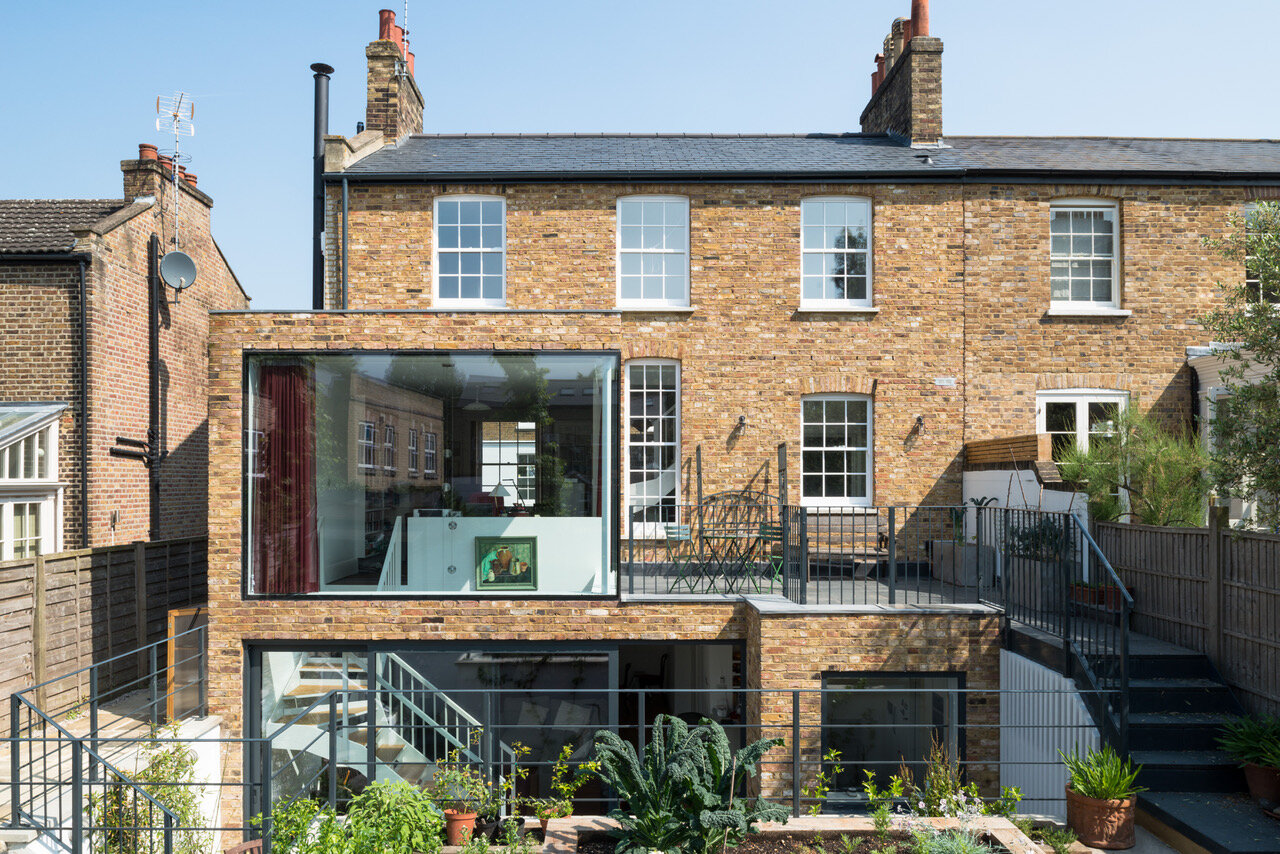

Great to see our Greenwich Garden Studio featured in this lovely book entitled Work From Shed, published by Hoxton Mini Press. Photography by French + Tye.

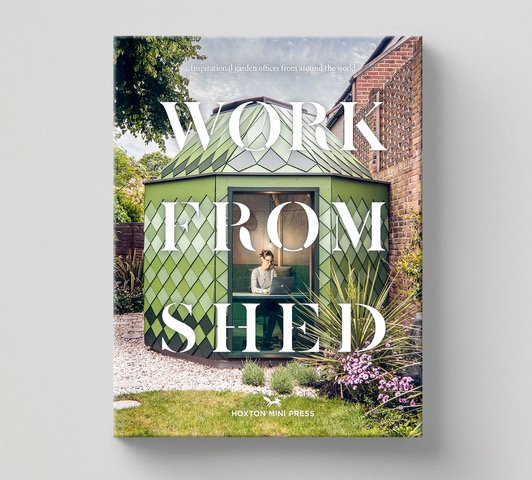
We are delighted to see so many of our projects featured in Mary Leslie’s fabulous new book entitled ‘Squeezing It In - Designing For Compact Spaces’.

Squeezing It in // Mary Leslie // Cover Image: Amy (AJ) Adams
“Our living spaces are getting smaller but, as we spend more time at home, they must now work harder than ever to provide us with room to relax, work and entertain. Interior designers need to understand how to build accessibility, circulation, storage and lighting into the most restricted areas without compromising on style.
In this jargon-free guide, Mary Leslie demonstrates how to design for compact living, proposing creative solutions that can be applied to a variety of settings. A versatile designer may be addressing a cramped studio flat one day and dressing room for an international business traveller the next; this book provides inspiration and advice for every kind of small space, and every budget.
Organised around the different areas of the home, Squeezing It In examines familiar problems and offers clever, immediately applicable ideas for making the best of pocket-sized spaces. The entire design process is considered alongside complete examples, from the UK and internationally, which are generously illustrated with full-colour photographs, plans and sketches.”
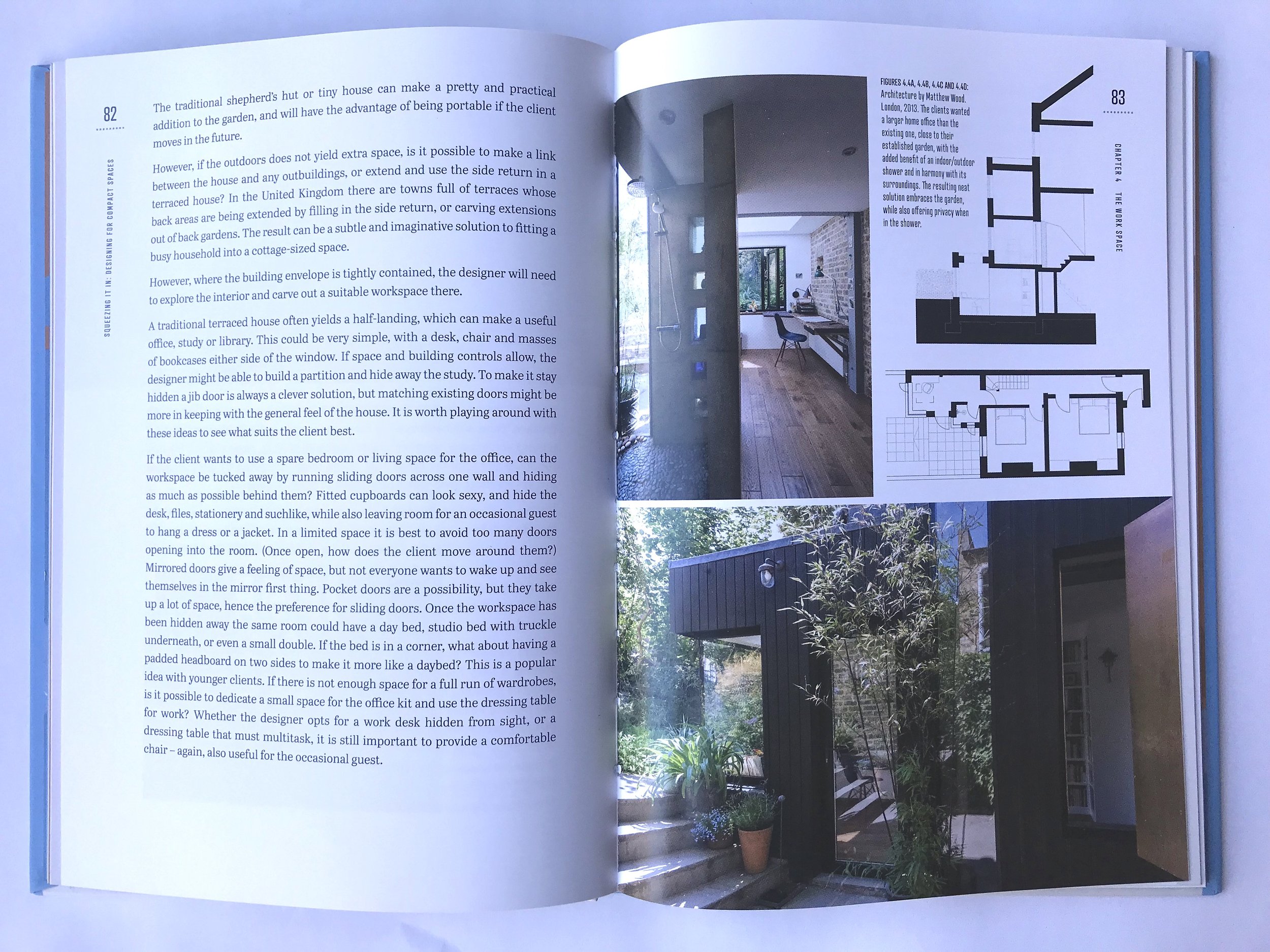
Squeezing It In // Mary Leslie // Photography by French + Tye

Squeezing It In // Marly Leslie // Photography by French + Tye

Squeezing It In // Mary Leslie // Photography by French + Tye

‘In The Picture’, an article showcasing the framing of beautiful views, features The White House kitchen and the clear visual and physical connection from the kitchen to the garden.
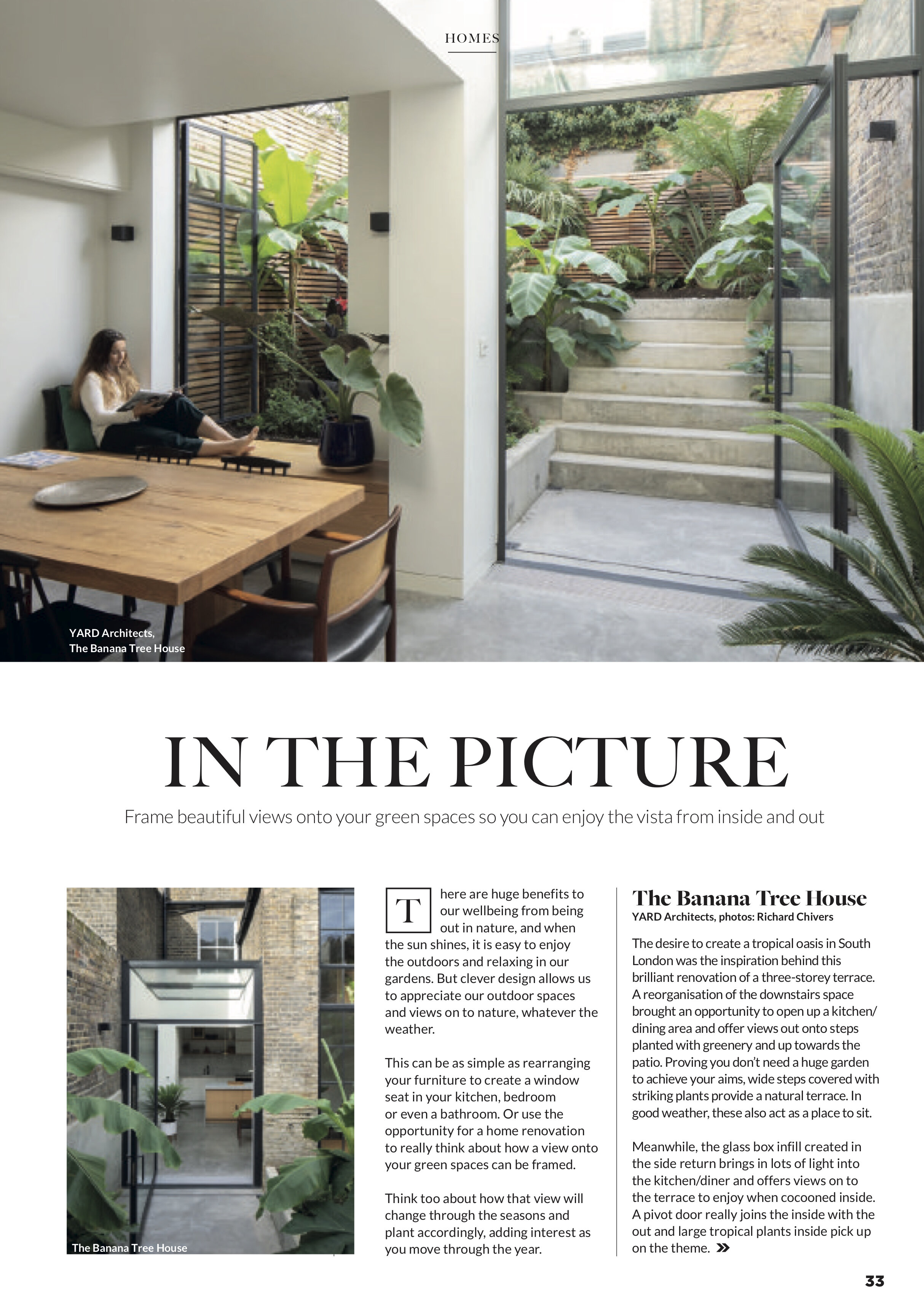
TIME & LEISURE MAGAZINE

TIME & LEISURE MAGAZINE // THE White House // PHOTOGRAPHY BY FRENCH + TYE
Cut and paste collaging is a technique that aims to give new meaning to pre-existing photos and forms. It’s an opportunity to see things differently, shift them around, discover elements once left out. I started exploring this form of artistic expression while I was in university and helped me challenge my design proposals. I found new inspiration on how to proceed with my project through cutting, pasting and exploding, physically altering the shapes of my designs to generate new ones.

Fig 1. MW ARCHITECTS WINDOW DISPLAY
Since then I’ve used this method in my personal work to convey my satirical view on current world events (fig 3) as well as to promote the work of MW Architects (fig 1) and assist in the design process. I’ve expanded on my methods of expression, from handmade and printmaking to digital collages and used multiple sources such as newspapers, magazines or targeted photos like in the case of MW Architects.
The creative method I follow is by expanding on the given topic both conceptually and physically while completing the collage. There’s rarely a specific aim or preferred outcome before starting. I initially start by cutting and exploding existing photos and forms to find ways to improve them visually. I simultaneously develop the theme by reflecting on the work so far and generate new ideas from it. This process runs in circles until the collage is completed.

Fig 2. DIGITAL COLLAGE
As an example, the collage above (fig 1) was composed after getting inspired by all the work MW Architects have completed so far. My initial mindless exercise was to cut out the outlines of the projects’ openings (visible on the top right of the collage), which led me to realize the importance of symmetry in their work so I proceeded in balancing the collage against a vertical axis. Simultaneously though, I challenged this by breaking this symmetry but making sure to keep a visual balance.
Collaging overall is a method that brings new life to old completed ideas. It is a method that is very open to interpretation and I believe can be very successful with conveying architectural design ideas: It sets a very broad yet a very defined base for discussion which can immensely help with developing the proposals. It can convey concepts without the use of strict sketch lines on a plan or an elevation which can prove very restricting sometimes. You can see all my work to date on instagram @delete-utopia.

Fig 3. DIGITAL COLLAGE
by Gina Andreou
Delighted to see our Greenwich Garden Room featured in ‘Out of Office’ Period Living June ‘21.

GREENWICH GARDEN STUDIO // PHOTOGRAPHY BY FRENCH + TYE
Council housing is usually viewed as homes built for the poorest of people where design quality is said to be undermined by poor construction. The usual perception of council estates is deemed to be poverty stricken, isolated by poorly lit walkways, surrounded by brutalist concrete walls and haven for crime and drug dealing. This stereotypical perception has encouraged private developers and local councils to target council housing estates for demolition and redevelopment.
Research has shown that currently 237 estates in London are facing or undergoing some form of regeneration; either for demolition or privatisation. The Institute of public policy research report, put together by Savills, produced for the government cabinet, titled ‘Completing London’s Streets’, recommends the demolition of homes of over 400,000 Londoners (Savills, 2016). Removing housing stock during a period of a ‘housing crisis’ and driving out low-income tenants from their homes instigates further problems in itself. We are not only demolishing building fabric, but more importantly we are fizzling out tightly-knit communities.
As I go through my final ‘home run’ of architectural training to become an Architect, this stigma on council homes is something I have always found immensely troubling. In architecture school we were told about the huge investments that were put into social housing during the post war years; local councils and housing associations teaming up with Architects to come up with pioneering initiatives to ramp up housing supply. ‘Housing for all’ was the aim, which brought about the beginnings of a welfare state.

PHOTOGRAPHY: ALEXANDRA ROAD ESTATE // KHALID AIDEED

PHOTOGRAPHY: ALEXANDRA ROAD ESTATE // KHALID AIDEED
Alexandra Road is a prime example of social housing schemes built in the 1970’s that provided a beacon of hope for middle to low income families in London, which was later Grade II* listed in 1993. However, the majority of these estates are not seen in the same light and their architectural asset and face seems to take more precedence over its purpose or most importantly the existing residents and users that occupy these spaces.

PHOTOGRAPHY: CENTRAL HILL ESTATE // ARCHITECTS FOR SOCIAL HOUSING

PHOTOGRAPHY: CENTRAL HILL ESTATE // ARCHITECTS FOR SOCIAL HOUSING
There lies a different fate with the Central Hill council estate, located in Crystal Palace South London, which is deemed not fit for purpose and since 2015 has been set for demolition and redevelopment by the council. There has been resistance against the redevelopment of the estate by the Central Hill residents who formed a campaign, named ‘Save Central Hill Community’. They made an alliance with the ‘Architects For Social Housing’ non-profit group to propose architectural alternatives to demolition and to find ways to increase capacity and to generate collective funds to renovate existing homes. Despite their efforts, their ideas were never acknowledge or considered due to the local authorities power of land ownership of the council homes. The futures of the local residents relies on the commercial incentives of the council (i.e the landowner) and the private investor. After all, their decisions are merely based on the socio-economic climate and the ability to sustain long term financial stability.
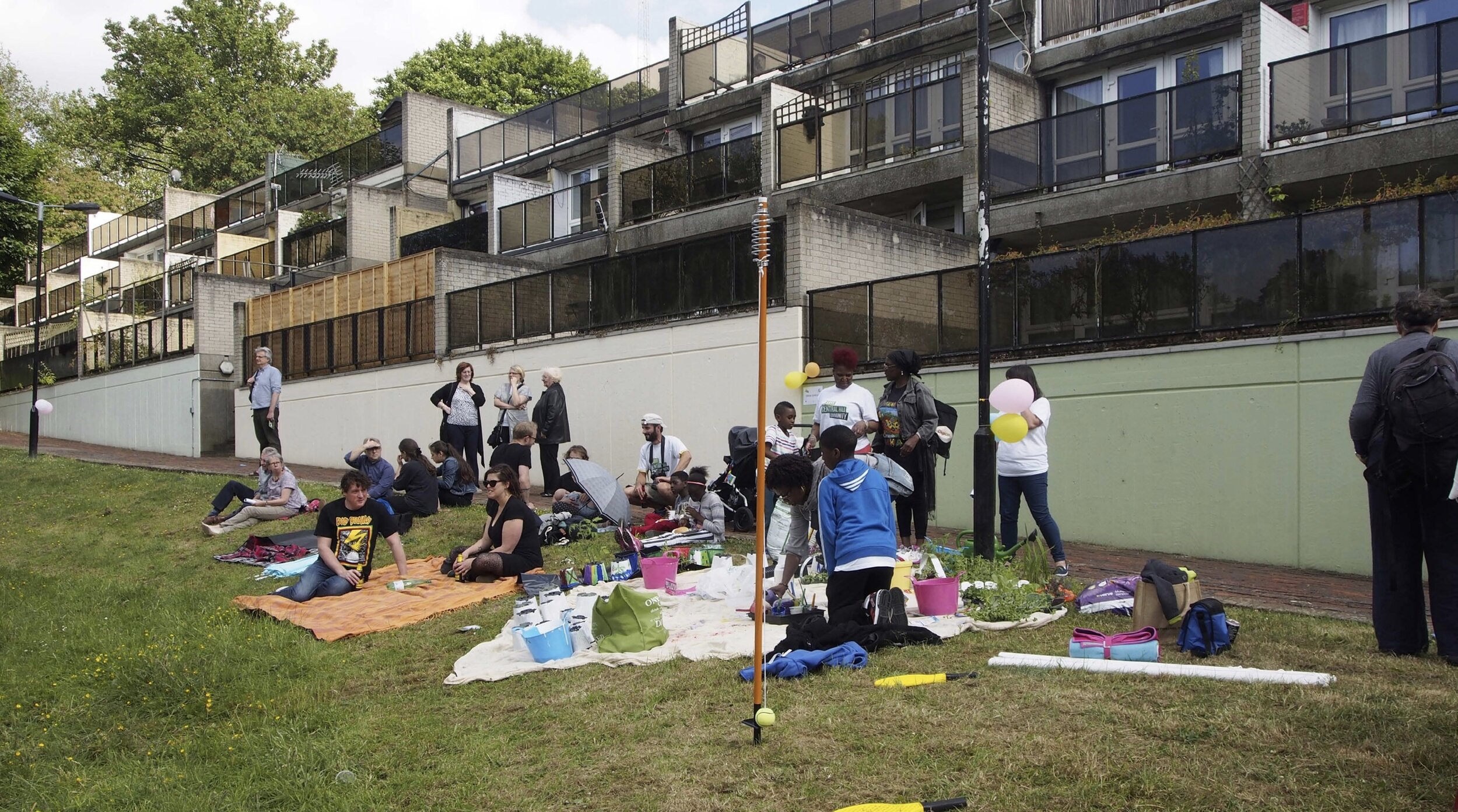
PHOTOGRAPHY: CENTRAL HILL ESTATE // ARCHITECTS FOR SOCIAL HOUSING
So where does this leave us and where could we do better?
Clarifying the term ‘affordable housing’, ‘social housing’ or ‘regeneration’ and what this all means for the residents, the council and the professions within the built environment would help in reinstating the purpose of council housing.
As Architects it is important to take into account the ultimate impact of our work. It is also difficult to deliver morally sound projects for the user where there are no policies, regulations, contracts or government body to protect the human right of tenants within council homes. I therefore implore all designers, professional bodies, government and non-government bodies to engage with and listen to the voices of the residents to more widely help co-design and fabricate design policy. In a time where the new generation struggle to get onto the housing ladder, it is now time to think outside the box and propose innovative and alternative ways of living.
By Khalid Aideed
As architects, we often find ourselves dipping our toes into other creative outlets, perhaps often craving avenues where there is a shorter turnaround time for the finished product. Working on architectural projects, we often don't see a finished outcome until at least 12-18 months later, and after extensive periods of stress, hard work and delays. Whilst it is incredibly satisfying to see the end result, it is not without considerable time and input.
Almost 4 years ago, after just qualifying as an Architect, I was having a really difficult time personally, had started talking to a therapist and was looking for a creative outlet where I could have a few hours to switch off my mind from it all. I had always wanted to try ceramics, and get my hands stuck into clay, and so with the offering of a space on a 12 week ceramics course, I signed myself up at Skandihus to give it it a go.
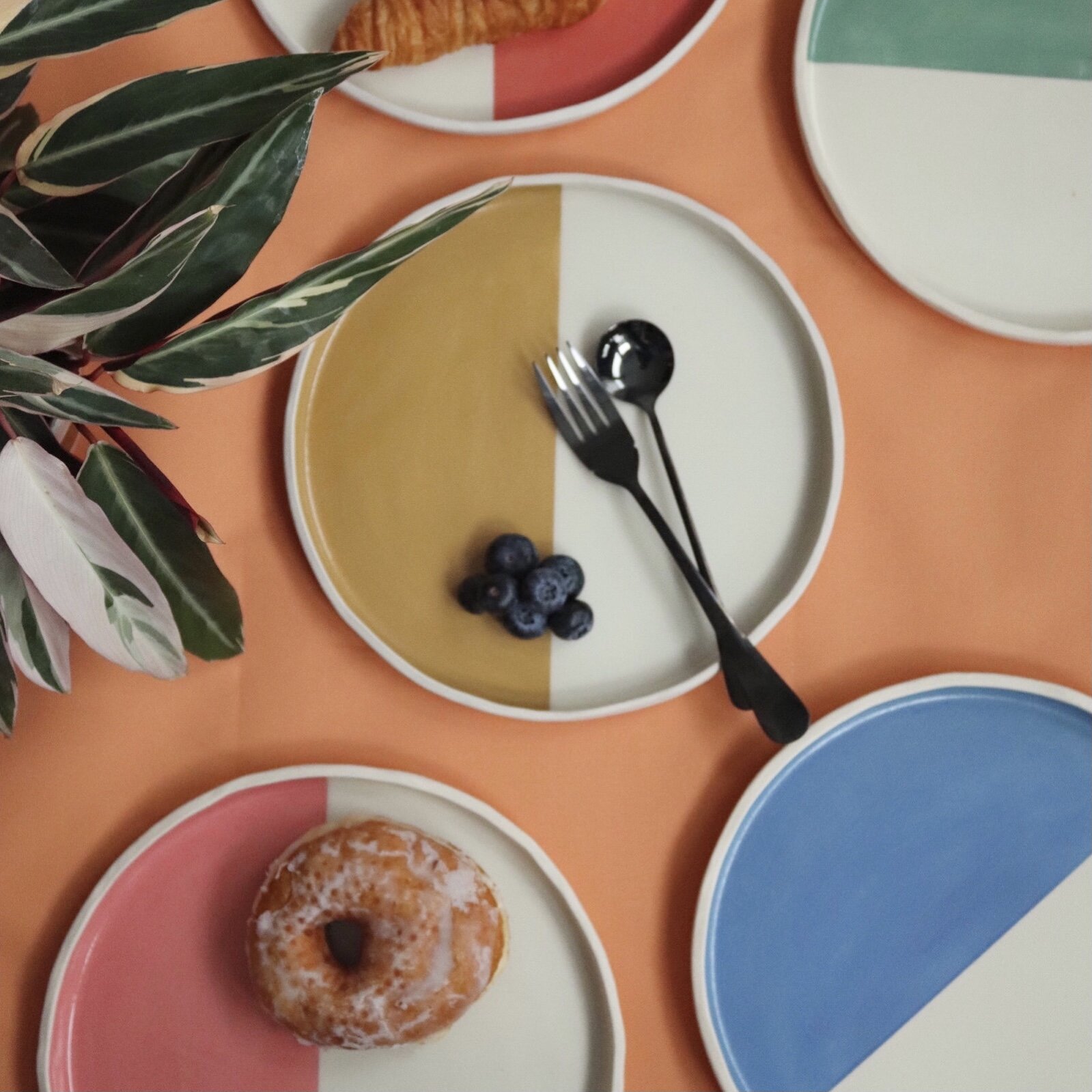
half moon dinner plates

DOTTY SERVING PLATES
Being somewhat of a perfectionist, I learned very quickly that - despite your best efforts - you cannot completely control a natural material; and that when the kiln gods are not on your side, the pieces you have taken such care and thought with, can often come out of the kilns very different to what you expected!
Whilst there can often be disappointments, there is utter joy from being able to take a lump of clay, mould it, shape it, paint it and make it a permanent object in just a few weeks.
There are endless ideas and designs to explore and the beauty of being able to take a quick hand sketch, or idea in your head, and use your hands to create it - without any restrictions or policies to say otherwise, is a stark and wonderful contrast to my day to day job as an architect.
After spending 12 weeks elbow deep in clay, I knew I didn't want to give it up and so I moved onto becoming a member at Turning Earth Studios in Hoxton. Whilst here I was able to develop my own style of ceramics, which became all about simple, functional forms but with bright, colourful graphics, all of which are individually hand-painted. I particularly enjoy being able to be playful and bold with my use of colour and pattern - as I am not always able to convince our clients to be so daring!

hand-painting each piece
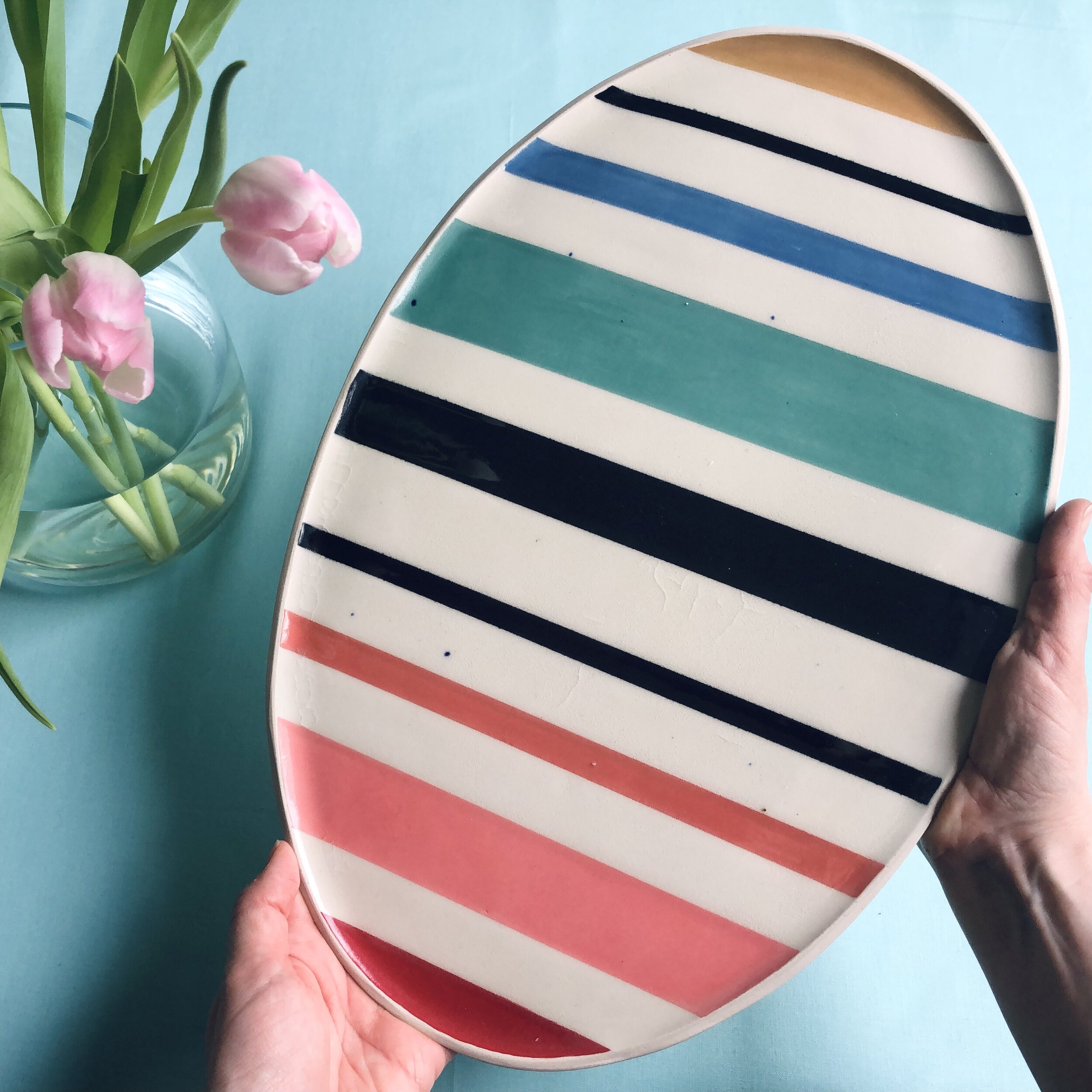
rainbow stripe platter
I continue to find that ceramics develops a lot of the skills that assist with my architectural career and that it has taught me to be more patient, confident - and adventurous - with my work in both the MW Architects studio and at my new studio space at The Kiln Rooms in Peckham. My ceramics pieces have now been sold online, at markets and soon to be on Not on The High Street and you can find images of all my work to date @cp-ceramics.
by Clare Paton
Extending and refurbishing existing properties not only gives the opportunity to upgrade the internal look and feel of the property, but it can provide much needed energy improvement too.
Read More