Designing a Healthy Home: Combining Retrofit Steps with your Refurb

What is Retrofit?

Refurbishment and retrofit are often used interchangeably. While they are siblings within the same family, and can absolutely be carried out in parallel, they are two distinct actions, and understanding the difference is key in taking up ownership over what options you have in regards to upgrading your home.

As a simple analogy, retrofit and refurb can be thought of as types of surgery - refurbishment as cosmetic surgery and retrofit as medical surgery. Refurbishment improves the surface, layout and appearance of a home; retrofit goes deeper addressing building fabric, insulation, structure, airtightness and thermal efficiency. So while retrofit might not be as glamorous as refurb, it can address deeper thermal or structural parameters relevant to your home and improve the comfort and resilience of your home. Tackling both at the same time can be a good way to make the process more efficient, minimise cost and create a healthy and beautiful home all in one! 

Throughout this blog post, I aim to shed light on retrofit for homeowners, deepening understanding of how retrofit measures can be integrated into a refurbishment project, while also highlighting small, achievable changes that empower you to improve the thermal comfort of your home, reduce your energy bills and create a more sustainable, healthier place to live.

If sustainability is important to you (and it should be), I will also explain the difference between two key terms - embodied carbon and operational carbon and how you can reduce both. Understanding these concepts before starting a house refurbishment allows sustainability principles to be embedded alongside design intent - from that very first design meeting through to completion. 

Why Retrofit Matters Now

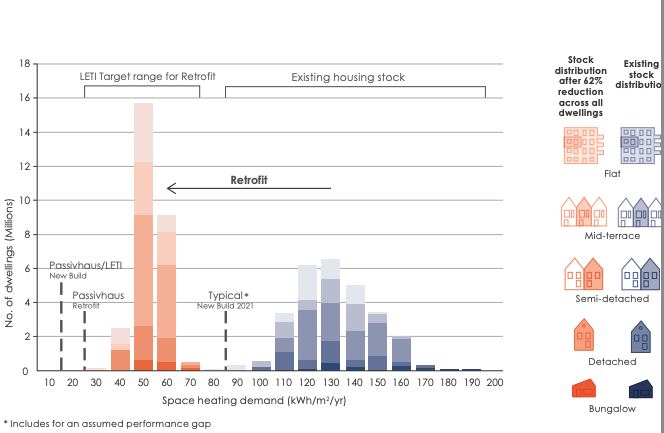
The magical thing about retrofit is that it aligns your interests as a homeowner in having a happy, healthy home and lower energy bills - with the UK’s sustainability goals at large. The UK has legally binding carbon budgets on the path to net zero by 2050 and the UK’s 25 million existing homes contribute to approximately 18% of the nation’s carbon emissions and consume around 30% of the country’s energy. (1) Crucially, most of the buildings that will exist in 2050 already exist today(2). This makes refurbishment and retrofit one of the most powerful tools we have to reduce emissions at scale. Delaying retrofitting while the grid decarbonises only increases whole life carbon making the next decade a critical window for addressing retrofit in the built environment. (3)

Figure 1. Total number of UK dwellings broken down by their space heating demand, showing the transition required from existing levels of high demand to the LETI retrofit target range. Figure based on stock modelling carried out by LETI.

Operational Carbon 

Operational carbon refers to greenhouse gas emissions associated with the day-to-day running of a building, e.g. by electricity, gas, or other fuels.

 As the national grid decarbonises, ie. transitioning away from fossil fuels towards renewables and nuclear, operational carbon will inevitably decrease. The next few years are therefore crucial: decisions made now should support this transition and future-proof homes for a low carbon energy system.

Replacing your boiler today with another gas boiler  would mean:

  • You continue emitting operational carbon due to gas

  • There is embodied carbon associated with manufacturing and installing the boiler

  • Whilst gas boilers are not banned yet, the UK government is planning to phase them out which creates some unpredictability

It’s important to have a ‘whole house’ approach for each case, as each building is different and comes with its own bespoke set of existing conditions. A whole-house approach will maximise energy savings and balance issues of moisture, comfort and heat. For example, if a heat pump was installed without reducing the energy demand of a building first, the energy bills would get higher as electricity is currently more expensive than gas. 

Figure 2. Performance-oriented retrofit. Shifting in favour of better performing retrofit, with wide-ranging systemic impacts. Illustration by Dark Matter Labs ‘Scaling the Right to Retrofit’ https://provocations.darkmatterlabs.org/scaling-the-right-to-retrofit-3b74aa6b08ad

Embodied Carbon 

Embodied carbon accounts for the greenhouse gas emissions generated across the entire lifecycle of construction materials - including extraction, manufacturing, transportation, installation, maintenance and eventually demolition. 

Here, sustainability requires balance: the carbon required to produce the material must be weighed against its durability and lifespan. For example, many concrete buildings constructed over 50 years ago, such as the National Theatre by Denys Lasdyn, can arguably be considered sustainable despite concrete’s high embodied carbon. Their longevity has effectively ‘locked in’ that carbon, and demolition is unlikely.

Some natural materials such as timber and cork, go a step further by sequestering carbon, which means they absorb CO2e from the atmosphere and store it long term. Stone, a material currently having a resurgence, has a long history in UK construction, excellent compressive strength and 75% lower embodied carbon than brick, making it a compelling low-carbon material that comes in varying forms and sizes, including in brick form. 

Whole Life Carbon

Whole Life Carbon considers both embodied carbon and operational carbon across the entire lifespan of a building. Achieving low whole life carbon requires a delicate interplay between 

  • Low embodied carbon material specifications

  • Reduction of heat loss through well-detailed and well-insulated fabric

  • Minimising draughts through airtightness and upgraded windows and doors

  • Introduction of renewable technologies - heat pumps or PV

Timing is critical when thinking about whole life carbon. In some cases, the embodied carbon cost of replacing a building element before the end of its useful life can outweigh the operational carbon savings. A whole-life approach helps identify when to upgrade, and when it’s better to wait. 

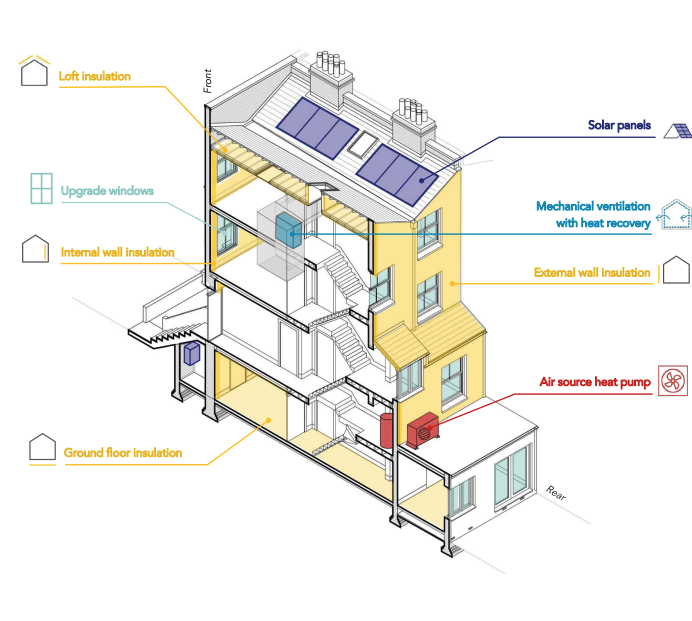
Figure 3. Potential retrofit steps in a Victorian terraced house. Illustration taken from Part 2a Victorian House:  A retrofit guide for residents, ESSA local conservation association website: https://files.websitebuilder.prositehosting.co.uk/ae/fc/aefc33f7-d928-4a7c-88d1-a29bf28b3e57.pdf

The Low Hanging Fruit

If you are planning to refurbish your house, this is a great opportunity to tackle those low-hanging fruit that can make your home slightly more thermally efficient. 

If you’re demolishing walls and adding an extension, specifying lower-carbon materials such as stone or timber, and minimising the amount of steel used, can meaningfully reduce embodied carbon.

Designing new wall build-ups with natural, breathable insulation - and exceeding Part L U-value requirements reduces heat loss. This, in turn, allows for: 

  • Smaller radiators or heat pumps

  • Reduced renewable system sizes

  • Lower capital and running costs

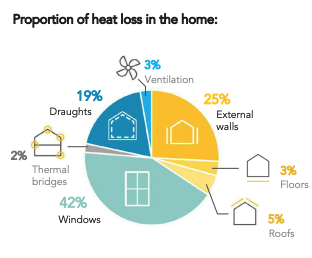
Taking a whole-house approach also means upgrading the existing fabric where possible. Loft insulation, in particular, is one of the most effective and affordable interventions,  as a significant proportion of heat is lost through the roof. 

Replacing single-glazed windows at the end of their life with double-glazed units can dramatically improve comfort - but only when replacement is genuinely necessary. Where windows and doors are serviceable, draught-proofing can make a noticeable difference. Where possible, avoid aluminium frames, which tend to have higher embodied carbon and poorer thermal performance.

Finally, it’s important to remember as homes become more airtight, ventilation becomes essential. Without adequate ventilation, moisture, condensation and mold can develop. A well-designed retrofit always balances airtightness with healthy indoor air quality. Installing an MVHR can help bring fresh air into your home without bringing in cold draughts.

Figure 4. Proportion of heat loss in a home. Illustration taken from Part 2a Victorian House:  A retrofit guide for residents, ESSA local conservation association website: https://files.websitebuilder.prositehosting.co.uk/ae/fc/aefc33f7-d928-4a7c-88d1-a29bf28b3e57.pdf

Renewables: The Final Step

By retrofitting your home first, reducing heat demand through insulation and air tightness, and then installing an air source heat pump, you avoid unnecessary future replacement costs, take advantage of available grants and lower your energy bills from day one. Whilst the upfront cost of installation is a factor to take into account, replacing a gas boiler with a low carbon technology such as a heat pump can save a four bedroom house up to £1,300 annually on heating bills.

Combining retrofit steps with refurb

For a private residential extension, key ‘trigger points’ within the extension and refurbishment can act as ways to lock in retrofit measures, in accordance with Part L in the Building Regulations which mandates that when a specific part of the building is renovated, it must be upgraded to improve their thermal efficiency to meet specified U-values. This allows incremental progress towards energy efficiency without requiring immediate full-scale retrofits, making it accessible for a broader range of budgets and hitting two birds with one stone.

Combining retrofit steps alongside your refurb also helps reduce the mess and disruption. Whilst you already are pulling up floorboards and ceilings, why not add in some MVHR ducting or insulation? The phasing of the retrofit steps can and should absolutely run in parallel with your refurbishment. 

Ultimately, the most efficient approach is to treat refurbishment and retrofit as partners. By capitalising on natural ‘trigger points’ during a renovation you can significantly reduce disruption and cost. This integrated strategy allows you to lock in energy efficiency immediately ensuring your home is not only aesthetically updated but also future-proofed against rising bills and ready for a low-carbon future.


by Constantina Antoniadou

(1) London Energy Transformation Initiative (LETI), Climate Emergency Retrofit Guide (London: LETI, 2020), 18, accessed September 18, 2024, https://www.leti.london/retrofit.

(2) London Energy Transformation Initiative (LETI), Climate Emergency Retrofit Guide (London: LETI, 2020), 18, Accessed February 02, 2026, https://www.leti.london/retrofit.

(3) Whole Life Carbon Study: Five Lewisham Primary Schools - Retrofit vs Demolition. Retrofit Action forTomorrow for the UK Department for Education, September 2023, 42

(4) UK Gas Boiler Ban - In Effect from 2025 or 2035? https://www.greenmatch.co.uk/boilers/gas/ban

(5) Ministry of Housing, Communities & Local Government, Approved Document L: Conservation of Fuel and Power, Volume 1, Dwellings, 2021 edition incorporating 2023 amendments, Section 11.
U-values are a measure of how effective a material is as an insulator. For more information read our other blogpost: https://www.mwarchitects.co.uk/ask-the-architect/2024/5/3/what-is-a-u-value

(6) MVHR’s are an energy-efficient, whole-house ventilation system that provides constant, filtered fresh air while recovering up to 96% of heat from exhaust air. It removes moisture and pollutants to improve indoor air quality, making it ideal for airtight new builds. The system reduces heating bills by recycling warmth back into the home.


What are Contractors Attendance Fees?

In the context of residential projects in the UK, it is common practice for contractors to charge an attendance fee when clients supply fixtures and fittings or subcontract certain areas of work. This fee, known as the attendance fee, serves multiple purposes and helps ensure the smooth execution of the project.

The attendance fee covers the contractor's time and expenses associated with overseeing and coordinating the work performed by subcontractors or the installation of client-supplied items. It compensates the contractor for their presence on-site, ensuring that the subcontractors adhere to the project requirements and coordinate the installation of client-supplied fixtures and fittings. This involvement is crucial for maintaining quality standards and ensuring that the project progresses efficiently.

One important aspect to consider is compliance with Health and Safety legislation, specifically the Construction (Design and Management) Regulations (CDM). These regulations require contractors to plan, manage, and coordinate construction work to ensure the health and safety of all workers and those affected by the works. The attendance fee contributes to ensuring compliance with these regulations by allowing the contractor to allocate resources to oversee and enforce safety measures, specifically when working with client nominated sub contractors.

Additionally, the attendance fee also takes into account potential waste removal, such as packaging from the client-supplied items. The contractor normally operates on a fixed fee contract, which included the cost of waste removal which can be significant and require additional time and resources.

Furthermore, the attendance fee considers the potential disruption to the main contractor's workflow. When subcontracting certain areas of work, the main contractor needs to ensure that the space is ready for the subcontractor on a specific day and that they cannot work in the same areas, which may disrupt their programming. The attendance fee compensates for the extra coordination and planning required to minimise disruptions and ensure the smooth progression of the project. Note however that this does not remove the potential liability for unexpected delays caused by client nominated subcontractors. If the subcontractors do not adhere to their agreed program, the main contractor may still be entitled to claim and extension of time and additional costs.

Overall, the attendance fee is a standard industry practice that helps to ensure the smooth progress of residential projects in the UK. It facilitates effective coordination, compliance with Health and Safety legislation, waste removal, and minimizes disruptions to the main contractor's workflow. By understanding the purpose and importance of this fee, clients can appreciate its value in guaranteeing a successful and secure construction process.

Shared Drains - what are they and what to do about them

Shared Drains in London: What You Need to Know


If you own a property in London, there is a good chance that you have a shared drain running through your land. These drains carry waste from neighboring properties, making them the responsibility of Thames Water for maintenance and repairs. However, when it comes to building extensions or making any alterations near these drains, there are important considerations to keep in mind.
One key issue with shared drains is access. These drains often run very close to the rear of buildings, and if you plan to extend your property, you may need to build over the drain. This can become problematic if access is required to fix any blockages or issues that may arise in the future. Imagine completing your beautiful extension, only to find out that access to the shared drain is now obstructed.


Not only is lack of access a concern, but accidental damage to the drain during construction can lead to even bigger problems. If you unintentionally damage the drain while building your extension, the responsibility for repairs falls on your shoulders. This might even result in the need to demolish parts of your newly built extension, causing significant financial and logistical headaches.


To avoid these potential pitfalls, it is crucial to follow the correct procedures when building close to or over a shared sewer. Typically, this involves ensuring that your foundations are at least 300 or 600 mm away from the drain, depending on its size and depth. Additionally, the foundations should be deeper than the drain to prevent putting any additional load on the fragile pipes.


In some cases, it may be necessary to relocate access points and inspection chambers, ensuring that Thames Water can still access the shared drain in case of emergencies. Access points cannot be inside the building, as this would hinder Thames Water's ability to carry out any necessary maintenance work.


If the conditions surrounding your build are relatively straightforward, your architect, structural engineer, or builder can self-certify the build-over agreement. However, if the situation is more complex, a formal build-over agreement must be arranged with Thames Water. This process may involve submitting detailed drawings, structural calculations, and possibly even inspections. It's important to note that this formal agreement can be both time-consuming and expensive, so it's always wise to be prepared for the possibility of it being necessary.


In most cases, your building control authority will notify the water board when a build-over or construction near a drain is likely. However, it is advisable to be proactive and anticipate the need for a build-over agreement ahead of time. By doing so, you can prevent unnecessary delays and costly design alterations during the construction process.


Navigating shared drains in London requires careful planning and adherence to Thames Water's guidelines. By understanding your responsibilities and following the correct procedures, you can avoid complications, ensure access for maintenance, and safeguard the integrity of both your property and the shared drain system in your neighborhood.


Combi Boiler v’s System Boiler (sometimes referred to as Megaflo)

Pros and Cons for House Renovation

Choosing the right heating system for your house renovation is a crucial decision that can greatly impact the comfort and functionality of your home. Two common options to consider are a combi boiler and a system boiler with a hot water cylinder. Each has its own pros and cons, including factors such as cost, space utilisation, and usability. Let's explore the principle differences between these two options to help you make an informed decision:

Combi Boiler:

A combi boiler, short for combination boiler, provides both hot water and central heating in one unit. Here are its pros and cons:
Pros:
1. Space-saving: Combi boilers do not require a separate hot water cylinder, saving space and potentially freeing up room for additional storage or living space.
2. Efficiency: Combi boilers heat water on demand, eliminating the need for storing hot water in a cylinder. This can result in increased energy efficiency and lower heating bills.
3. Hot water anytime: As the water is heated directly from the mains supply, you can enjoy hot water almost instantly at anytime, without having to wait for an entire cylinder to heat up. So you can have unlimited amount of hot water but only at the flow rate it can cope with.
4. Installation cost: The installation of a combi boiler is generally less complicated and time-consuming compared to a system boiler with a cylinder, which can potentially lower installation costs.
Cons:
1. Limited flow of hot water supply: Due to the absence of a separate hot water cylinder, the flow of hot water supply from a combi boiler is limited. This means that simultaneous usage of multiple hot water outlets may reduce water flow or temperature. If you envisage using multiple bathrooms simultaneously this is probably not the best option for you.
2. Pressure fluctuations: As combi boilers rely on mains pressure, water pressure fluctuations can occur, leading to variations in the performance of showers and taps. It is possible to use an accumulator tank with a combi boiler that will increase the flow and pressure going into the boiler but this might negate many of the advantages, ie you need to accommodate a large accumulator tank.
3. Incompatible with high pressure / high flow showers: Combis may not be suitable when considering powerful showers, as their water flow rate can be limited. So if you are thinking about having a rain shower or body jets, a combi boiler probably won’t cut it.

2. Intermittent temperature: If you use short burst of hot water for any reason, a combi boiler can be a little frustrating as the burner fires up and shuts off on demand. This means that it might take a few seconds for the hot water to arrive at the tap and every time your turn the tap off and on again, a small amount of cold water will enter the system creating a potentially annoying fluctuation in temperature. Some boilers have a small hot water storage tank built in which can help mitigate this problem.

System Boiler and Hot Water Cylinder:

A system boiler works in conjunction with a separate hot water cylinder to provide central heating and hot water. Here's what you need to know about its pros and cons:
Pros:
1. Greater hot water capacity: The presence of a hot water cylinder allows for a high flow of hot water supply, making it ideal for households with multiple bathrooms or high-demand hot water usage.
2. Hot water performance: With a system boiler, you can expect consistently strong water pressure and flow, ensuring an enhanced shower experience. If your main pressure is low it is possible to use an accumulator tank and pump or of course an traditional tank in the loft with a system boiler to create high flow and good pressure.
3. Compatibility with power showers: System boilers are well-suited for powerful showers, as they have a higher flow rate and can handle increased hot water demands.
Cons:
1. Space requirements: System boilers require an additional hot water cylinder, which takes up additional space in your home, potentially reducing storage or living space.
2. Installation cost: Compared to combi boilers, the installation of a system boiler and hot water cylinder is generally more complex, potentially resulting in higher installation costs.
3. Hot water delay: As the cylinder needs to heat up, there can be a delay before hot water becomes available. This is particularly noticeable if all hot water is depleted.
In summary, choosing between a combi boiler and a system boiler with a hot water cylinder for your house renovation should consider the specific needs of your household. Combi boilers are typically more space-efficient, energy-efficient, and cost-effective to install. On the other hand, a system boiler with a separate hot water cylinder offers greater hot water capacity, performance, and compatibility with power showers. Assessing factors such as household size, hot water demand, available space, and budget will help you make an informed decision that best suits your requirements.

NB A megaflo is a brand name for a mains pressured hot water cylinder compatible with a system boiler (others are available).

Communication and Co-ordination

One of the most important things in any construction project is clear communication and co-ordination from the very initial ideas through to completion and snagging. Without this, problems can include lack of understanding, abortive works and implications on the time and cost of the project.

The best way to combat this is to establish clear communication channels early on and outline the expected communication frequency and preferred methods between all parties.  It is important to have specific channels for the line of decision making and information distribution that has to happen over the course of a project.

Regular team or client meetings and project management tools can be utilised to discuss project updates and manage expectations for the length of a project.  Ensuring that meetings are effective is also important, so ensuring you have a clear agenda and understanding which items are most relevant to the project’s critical path will help you to do this.

Clear documenting of decisions is vital as this leaves a clear trail and avoids abortive costs where possible - this also helps avoid misunderstandings and disputes as everyone is clear on where to look for information.

There are often conflicts between clients and contractors on site, so establishing early on what is going to work for everyone really helps a project run smoothly.

Sometimes project can have 1000’s of emails under several different headings and multiple erratic decisions made and changed again and again.  To be frank, this is not helpful for anyone, so we have learnt to ensure we have a clear method for every decision that needs to be made from the initial space design down to the last door handle.

Here’s Matthew giving you a quick overview of the project management software we use:

It costs too much to use an architect!

The Cost of Not Using an Architect: A Wise Investment

When embarking on a construction project, particularly with a tight budget in mind, it's natural to want to cut costs wherever possible. However, there's a common misconception that hiring an architect is an unnecessary expense that can be skipped. In reality, the cost of not using an architect can often outweigh the initial investment. Here are some compelling reasons why you might want to consider hiring an architect, even when your budget is limited.

1. Cost Efficiency

One of the most immediate concerns when working with a limited budget is keeping costs down. Ironically, this is where an architect can truly shine. They have the expertise to design spaces that maximize your resources. By suggesting cost-effective materials, efficient layouts, and construction methods, an architect can help you get the most value out of every dollar spent.

2. Quality and Functionality

Quality and functionality are essential aspects of any construction project. An architect ensures that your project not only looks good but also works well. This can prevent costly mistakes or redesigns down the road. Their design expertise can lead to spaces that are not only aesthetically pleasing but also practical and comfortable.

3. Permitting and Regulations

Navigating the complex web of building codes and regulations can be a daunting task for anyone not well-versed in construction law. Architects are intimately familiar with these requirements, ensuring your project complies with all local regulations. This can save you from costly fines and delays due to non-compliance.

4. Resale Value

Consider your construction project as an investment in the future. A well-designed and architecturally sound home or building often has a higher resale value. While it may seem like an upfront expense to hire an architect, the increased value of your property can potentially offset these costs when it comes time to sell.

5. Energy Efficiency

Sustainability is increasingly becoming a top priority for homeowners and businesses alike. Architects can incorporate sustainable design practices that not only benefit the environment but also your wallet. Energy-efficient features can lead to lower utility bills over time, reducing your operating costs and making the architect's fee a wise investment.

6. Contract Administration

Some architects offer contract administration services as part of their package. Effective contract administration can help you stay on budget and avoid unexpected expenses during construction. Architects can act as a liaison between you and the contractors, ensuring that the project stays on track, as well as assist in the 1000’s of decisions that are required, even on a small job.

In conclusion, while it might seem tempting to cut costs by forgoing an architect, it's important to consider the long-term implications. The cost of not using an architect can result in suboptimal designs, costly mistakes, regulatory headaches, and missed opportunities for energy savings and increased property value. By investing in an architect's expertise, you're not just creating a structure; you're building a future with a solid foundation of quality, functionality, and efficiency.

Ask the architect

Matthew has been working in the residential refurbishment sector for over 25 years and has a wealth of experience with all things to do with home refurbishing and building. We are happy to try and answer any questions or queries we can regardless of if you have any intention in appointing us.

Feel free to post a question below and we will respond to it as quickly as we can.